Reflections

Sunday, 17 March 2013


This time we are taking a break from describing our journeys and adventures in order to look back and share some of the reflections that this travel evokes.

The Discreet Charm of Rough Tourism (Esther)

What I thought were the advantages of backpacking and rough tourism in my 20s –a more adventurous, less expensive way to see the world—have broadened in my 60s to include something even more precious: access to untouched natural landscapes and a window on local cultures and customs not yet americanized or blasé by meeting visitors who are clearly from another world .

We have seen so many beautiful places in the last weeks, so awe-inspiring, that we often turn to eachother to say how lucky we are. And indeed we are. But much of the beauty we have seen is precisely because it is vast and unpeopled and uncluttered by the volumes and infrastructure of mass tourism and economic development.

Peninsula Valdes, Chiloe Island, and the high Bolivian and Chilean Andes have particularly touched all four of us. Mostly we were alone among glaciers, gigantic sand dunes, snowcapped volcanoes and lagoons inhabited by flamingos, or salt water rivers created when entire forests were sunk during the last earthquake. Often we each found a small corner to enjoy the solitude that makes a spectacular landscape something more personally meaningful, even spiritual. And so, the same glacier or desert geyser experienced alone or shared with thousands of others becomes a different experience. One is nice, another life-altering. Which brings me back to backpacking and the pleasures of rough tourism.

In many ways backpackers are the thin edge of the tourism wedge. Mostly (very) young—20s and 30s with a few geezers thrown in – they thrive in shared dorms, showers and stories of rugged adventure. Lack of mass tourism infrastructure from hot water, toilets, and paved roads, to hotel and restaurant chains is catnip to them, ensuring only the hardy show up. Meals are found in common hostel kitchens or in the hospitality of a local family that makes rooms available in homes that range from rustic to falling apart.

Many of the places we hiked, kayaked or biked through had no powerlines for thousands of miles. Because of their beauty, within 20 or 30 years many will undoubtedly have flush toilets, WiFi and heavily roped off areas to protect the tourists as much as the delicate environments and animals. Access for all types of tourists will be available, but something will have been lost.

That´s why we are so grateful to be here. When we are biking uphill on the rockiest roads we have ever seen, or are faced with a meal that is not particularly recognizable, we know we are experiencing the area´s first experiments with tourism. Each time we are brought for the night to an adobe hut with rattling tin roof, broken or no toilet and a cold-water shower, we tell ourselves this is the price for access to some of the most beautiful, spare and lonely places on earth. And in the end, it is a very small price


A reflective moment (Annice)

One of the joys of this trip has been the natural beauty we have taken the time to sit, roll or walk through. So many memories come to me as I sit on a rock at the edge of the Laguna Colorada in Bolivia. In my minds eye I recall walking along the beaches of Peninsula Valdes marveling at the cliffs composed of crushed shells. Sitting by the glacial waters at the base of Fitz Roy and Torres del Paine, and kayaking around Grey glacier, and being in awe of the colours particularly the deep blue. The numerous sunsets, and occasional sunrises, especially kayaking at dawn on Chiloe island. The simplicity of standing on the deck of the ferry as it moves through the fiords. I feel the wonder of cycling along beaches and in the desert with no traffic, only the stillness of the vastness. At this moment the lagoon is red and thousands of flamingos pink and white are spread over the red water. Our altitude is over 4000 meters and there are no trees. The mountains in the background look as if they are carpeted in green and brown. In the distance there is a line of white salt, marking the edge of the water. The flamingos slowly walk, making a duck like sound, their images reflected in the clear water. Occasionally one flies by exposing the blackness at the bottom of their wings, making their flight an exquisite thing to watch. This is an ideal place to reflect on the beauty of this trip.


On travel photography (Simon)

As the chief photographer of this expedition I end up thinking (and talking) a lot about photography in general, and travel photography in particular. Many (most?) of our fellow wanderers snap a lot of pictures. Most carry small point-and-shoot cameras, some shlepp big and heavy packs with DSLR cameras and 2 or more lenses. I recently bought a nice Nikon DSLR with an additional large telephoto zoom lens, but before departure got cold feet, thinking about carrying it on the treks, in all weather, and in cities known for tourist predators, so I bought a much more compact Canon (not DSLR), with a lens too long to hide easily, but with a very powerful zoom, which I learned is very difficult to use without a tripod.

As a relative beginner and a learner I have to put  lot of thought and effort into trying to get the pictures I want, without disrupting too much the rhytm of our activities. My fellow travellers are mostly patient with me, and I hope they are rewarded by the visual memories of some remarkable views and moments we have shared.

Hummingbird
I find capturing images of animals (and particularly birds) in nature especially challenging, so I rarely pass by an interesting bird without trying to snap it, often without success, but I'm learning and slowly becoming better in overcoming the camera's and my limitations.

There is a lot I want to say about travel photography, but at this point I'll just use the opportunity to show our readers some samples my version on the birds of South America.


Vulture at dawn

Imperial cormorans

Petrel, I think


Chiloe Island - the last two days of our adventure

Friday, 15 March 2013


Just Hiking in the Rain:

We wake to our first overcast Chiloe day. Our hosts suggest that there may be some slight afternoon showers. We would later learn that ¨ slight showers¨ on Chiloe is relative to the usual tumultuous downpours that regularly batter its Pacific coast. So although we had come prepared, we decide to leave our serious rain gear behind for our day-long hike. (A big mistake) Eduardo arranges a water taxi at our dock to take us down close to the Pacific mouth of the Chepu River. On the way, the driver slows down and points out to us the different birds.


The clouds ominously darken as we reach land. Our starting point is a remote section of the Sendero de Chile, a Chilean dream to a have a continuous hiking trail spanning the country. We quickly reach the ocean and start crossing a 8km bay. Like our bike ride across Cocotue Bay, the beach is completely deserted except for the abundant sea life left by the receding tides, and the birds that feast on a soggy smorgasbord.
Geezers feasting on seaweed
Birds eating seaweed

A sea lion close to shore swims along with us, sharing a mutual curiosity. Then out of the mist we see a giant, beached steel hull. We would learn later that the ship was part of an unwelcomed Pilipino flotilla that had come to harvest local trees but the native sea gods had crashed the boat - but that is another story for another time.

As we leave the beach, the rain, which we had beaten back, decides it is time. We close our rain jackets and pull our hoods up, while Annice and Simon don their Nepalese ponchos. So far; so good. The trail begins to follow the area’s well-used cow trails. We carefully side-step their large aromatic,textured markers. We soon meet head-on herds of wary bovines. As a very large bull becomes quite displeased with our presence, Esther carefully removes the red towel tangling from her backpack.
We survive the cows as the trail heads deep into the rainforest that dominates the coast. Trails are now muddy, steep and slippery. The mud and cow dung become one raging confluence. Our previous careful dance of sidestepping it gives way to just hanging-on. We are amazed that cows easily negotiate this treacherous landscape.


Each time the trail leaves the relative protection of the trees, the full force of the Pacific rainstorm lashes out. We are utterly drenched but, in spite of the cold and wet, the beauty, solitude, and challenge we face keep us cheerfully moving on. We have a delicious and dry lunch, and by mid-afternoon return to meet our water taxi.
 Arriving back at our eco-camp, our hosts stoke the fireplace and get us dry and fed. We felt like superheroes!

A Magical Predawn Ride: A unique tradition of the eco-camp is an invitation to kayak the Chepu river before dawn. The night before, Fernando prepares us for the next morning ride: lectures about what to do, fitting us with cold weather gear, and most importantly how to mentally approach this eccentric trip. That night, the full force of a Pacific storm rages over us - our cabins shake with fierce winds and torrential rains.

At 6am when we rise, the storm seems to have moved on. We don our wet suits and by 6:15am, in total darkness, we are lovingly launched into the river.

A large, black cloud hangs over the sunken forest in front of us. Just as we turn our kayaks upriver, a shooting star streams through the clouds, leaving a luminous glow over our kayaks.


A bright night sky to our right shows us the way to Fernando’s Station A – where, in silence, we begin to attend to the awaking river. We move to Station B and we watch a dream-like sunrise dance on the waters around us.


We move up river and a perfect rainbow, fitted to the river, appears just for us. Then within seconds, it begins to pour, followed weirdly by hail. We turn our backs to the wind and soon, brilliant sunshine chases the hail away. We head back and just before we reach shore another rainbow appears followed by another downpour. A smiling Fernando is waiting to pull us ashore. We rush back to the eco-camp’s cozy lounge-dining room. The fireplace is fully stoked. Hot coffee and a hearty breakfast await us as we reflect on our strangely wondrous, mystical ride.
Eating with a view
With Amory and Fernando on the terrace
We all had an amazing 5 days. The biking, kayaking and hiking were all challenging with magnificent vistas-just the way we like them. The food was delicious, the accommodations spectacular and the people wonderful. Fernando's and Amory's place was truly paradise on earth. They were so caring and marvellous to us. Eduardo was a great guide and companion. He was delightful to be with and looked after all our needs.The trip was one of the highlights of our South American tour.
Our cabanas

Chiloe Island - Our Amazing Adventure Tour, Mar 1 - Mar 6

Sunday, 10 March 2013


On Land Again: Early Friday morning we disembark from our floating home. We somewhat guiltily admit that we enjoyed our four quiet days of being confined to no more that a couple hundred square feet - even walking more than a few minutes was nearly impossible. But we are now impatient to put the "motion" back into the "geezer".


Market view through a restaurant window
The renowned Angelmo fish market of Puerto Montt awaits us as we leave the ship. Weatherworn fisherman gut their watery hauls on the low tide rocks, surrounded by lazy, overfed seagulls. Fishmongers meticulously display all varieties of fish, seafood, seaweed, urchins - most of which are mysterious to us. Above the market, a ring of incredibly tiny restaurants (often with no more that 2 tables and a small, family stove top) offer the freshest, most exotic meals. We are determined, in the week we spend inת the area, to work our way through the local fish and seafood menus. (postscript from 7 days later: we did faithfully keep our promise and although it was all fresh and succulent, I am glad to be heading to the high northern deserts where nothing swims).

We leave Puerto Montt at noon to Puerto Varas, a picturesque German town, part of the Chilean lake district. Snow-capped Osorno volcano towers high over this tranquil lakeside village. The town's fascinating architecture is so dominated by its Germanic roots, it resembles an Alpine village, weirdly dropped into a South American landscape with a Chilean community. We spend a quiet evening indulging in seafood feast, waiting for our "adventure" starting early the next morning.

Day 1: Gravel Biking and 'Saving Jesus': At 8:30am, we leave the safe, civilized confines of Puerto Varas heading for our promised adventure on Chiloe Island. Chiloe is one South America's largest islands, just off the west coast of Chile. It is renowned for its rugged landscapes, warm communities and hundreds of Jesuit and Franciscan wooded churches (who arrived along with the Spanish armies in the 1500's). The people practice a fascinating blend of traditional indigenous rituals and Christianity.

We cross by ferry and meet our guide, Eduardo, in the one-street town of Chacao. Our modern mountain bikes are ready, lined-up in the town's busy square. Bikes of any variety are so rare that they always attract attention of curious locals and tourists. As we wait for our female riders, Simon and I spot a pickup truck backing up towards the entrance of the town historic church. In the back of the truck, a towering, mournful Jesus crucifix stands protected in a plastic case - he is being returned to the church after a recent festival parade. As several members of the congregation carry him out towards the church, it is obvious that their Jesus is much too heavy for them. An older, worried priest, directing the delicate maneuvers, anxiously nods in my direction. I immediately drop my bike and spring into action. The porters are now dangerously tipping Jesus in a desperate attempt to get him through the lower inner threshold. I rush in, grab the now falling Jesus and steady him. Successfully through the door, we now carry Jesus to his proper place on the front dais. I am thanked profusely, and as walk out of the church the thought comes to me that I had just 'Saved Jesus'.

With things now settled, we mount our bikes. Almost all Chiloe tours travel its protected eastern coast where most people live, where the roads are paved and where the weather is subdued. We, of course, instead head west, with its remote patches of civilization, gravel roads, rugged landscape and fierce weather.

Making curanto in the ground
The rocky gravel roads become challenging as we reach the sleepy Saturday afternoon Bay of Caulin. The bay is teaming with birdlife and harvested seaweed, drying on its shore. We bike by a crowd of villagers cooking mounds of curanto - a native dish of shelled fish, sausage, chicken, beef, and smoked pork, all stewed together in a pot over a fire, dug in the ground. We are invited to witness the event which we learn is a fund-raiser for an ill neighbour.


After a ride on the beach, we lunch at a tiny local restaurant. We start with insanely fresh oysters from the nearby bay. Our young waitress/cook/local interpreter then delivers plates of grilled salmon, explaining that they were caught yesterday by her father. She explains that the sea is the fabric of every thing they do.

We continue west, heading towards civilization and the city of Ancud. The roads are busier and we struggle with the dusty, rocky, steep ascents and descents. We are lucky as the always threatening Chiloe weather turns into calm, warm sunshine. Entering Ancud we cross a long busy bridge. Eduardo stays at the back, protecting our flank, but as the four of us enter the city, Eduardo has disappeared (but that's another story). In Ancud we start climbing again to its very top. Our destination is the historic Ancud Hotel - a beautiful Montobello-esque upscale (especially for us) hotel. It was built on the site of an old Spanish fort overlooking Ancud Bay. With the dust washed away in luxuriant showers, we collapsed on the hotel's grassy summit, watching the western sun set slowly in the water, carefully rehydrating ourselves with an aromatic bottle of Cabillera de Chile.

Walking to the kayaks in the morning mist
Day 2: Surviving the High Seas: Eduardo drives us back onto the rural roads outside Ancud. We make a sudden sharp turn off-road onto a wild, overgrown, dirt track, heading directly to the ocean. We collect our kayaks and gear at the beach-front compound of the tour company's owner. It's ground-zero for a number of small, ambitious initiatives. The plan for the day is to kayak Ancud Bay, passing the city, and reaching the remains of another Spanish fort at the mouth of the bay. It's a peaceful Sunday morning with a heavy, low-hanging mist, but with the promise of another warm, sunny day. By the time the kayaks are prepared, the sun has done its work and we set off into a clear blue sea and sky. We cross to the other side of the bay and head to its mouth, 8kms away, hugging its rugged coastline.


Spectacular birds (Simon was in heaven snapping their pictures) accompany us on our journey.

After several hours of serene paddling we reach the edge of the bay, and disembark to visit the ghosts of the Spanish fort. At a nearby secluded beach, we are rewarded with a pasta lunch. Mid-afternoon, we start heading back and now it's the sea lions that playfully swim around our boat. As we head towards the bay crossing the Pacific winds and tides wake-up. The now face a swelling, cold angry sea. Esther and I are in a long, heavy tandem kayak that falls deep and rises high in the churning waves that splash over the bow. It's a frightening balancing act as we charge across. Our guide is ahead of us, Simon and Annice behind. We all battle the stubborn waves until our arms ache, arriving safely at shore. We are finally starting to realize that our tour company, Austral Adventures, take the second part of their name very seriously and that we have 3 more days of ¨adventure¨.


Day 3-Bike Surfing We start riding out of Ancud, cycling the steep hills along the Pacific coast. It is another gorgeous summer day, totally atypical to this stormy Pacific island. The summits reward us with panoramic views of pastoral fishing villages and deserted beaches far below. We reach Chiloes western tip and start heading south along its fully exposed, remote Pacific coast. We descend through a winding back road to Cocotue Bay beach. White capped waves pound the 7km completely isolated beach. We ride onto the beach to ¨surf¨ its receding low-tide waters. The remains of the retreating fecund sea lie strewn along the vast open sand.
Playing with sea weeds
We detour around mounds of impossibly tangled sea weed, shells of every description, stranded crabs, and of course, birds that feast on the sea´s abundance. The bright sunshine and cool sea breeze accompany us we glide easily along the bay.

We leave the beach through a crazy uphill trail and then coast downhill to the seaside town of Punihuil - a whacky collection of beach huts for the boat companies and restaurants that support the main and only attraction trips to the hundreds of penguin colonies on a series of outcrop islands just kilometers offshore. We park our bikes, are fitted with lifejackets, mount a small wagon and are unceremoniously wheeled out to a waiting boat.

Magellan and Humboldt penguins are lined-up like statues, up and down the steep rock faces of the small islands. It hardly seems like preferred real estate but they insist on coming back every year to breed. We sail through the rough seas, skirting the rocky shores with our captain, an expert in birds and, obviously, in avoiding the dangerous waters.

By late afternoon we are ready to head to our next destination, an Eco-camp in the Chepu River Valley, about 30kms away over the high rolling western hills. We decide to skip the bike ride and Eduardo packs us into his 4x4 truck. As his truck struggles to make it up and down the rocky road, we know that we had made the right decision.

The Chepu  River Valley is home to one of nature´s most strangest freak shows. During the massive 1960 Chilean earthquake, a 15m tsunami stormed up the Chepu River. As it retreated the ground dropped 2 metres, submerging hundreds of acres of forests on the river´s low lying southern shore. As we arrive at the eco-camp, we are greeted with a surreal landscape, across the river, bare tree trunks tilt at every possible angle. It bizarrely resembles the remains of a nuclear blast, with dead trees standing where the forest was. This was caused by the 1960 earthquake, when a huge area sunk 2 metres down. The camp sits just on the other side of the river. We have wonderful cabins fitted with oversize picture windows with perfect river and forest views.

Pre-dawn kayaking on the river
Over the next two days we learn the remarkable story of our two hosts, Fernando and Amory, a professional couple that fled the noise and bustle of Santiago to create a literal ¨paradise on earth¨. Fernando used his engineering skills to build an energy self-sufficient compound, and a rain collection system to supply their water needs. Their British software wizard, Leonard, is automating all their operations including right index finger scan used for check-in, left finger scan used for liability release forms and  water-level monitoring used to control how many reservations could be  taken. But more than all this technology was the way, they all took care of our every need: gourmet food served with unlimited flowing wine, clothes dried when wet, lunches packed to survive floods, and, of course, great companionship. The highlight was a pre-dawn kayak trip on the river flowing through the sunken forest.

It was to be an exceptional two daysstay tuned.

Feb 25-28 Chilean Cruising:"Do Boats Beat Boots"

Saturday, 2 March 2013

Annice´s postscript to the Torres del Paine trek:
a comment about how an error can be to one's advantage. We had paid for 5 nights in refugios and they had only reserved 4 nights. The refugio we were supposed to stay in was full. I had spent a lot of time on these arrangements and was very annoyed. We were offered another option, a refugio defined as "rustic". Fortunately we had no choice. The accommodations were great, we had a large room with 2 sets of bunk beds, a shelf and hook for each bed, which for a refugio is luxury. It turned out to be a great destination for a rainy day, and enabled us to kayak around the Grey glacier. 

And now to the cruise:


The Evangelistas in Puerto Natales
1. Evening Departure: Our next adventure is a 5-day, 1500km ride from Puerto Natales (PN) to Puerto Montt. Our transport is part cargo ship, part ferry - Navimag's "Evangelistas".
We board at 10pm strolling through the tranquility of PN's virtually abandoned port. The ship delivers PN's weekly supplies so while we sleep mammoth trucks rumble in and out the ship's massive double hull.


Puerto Natales from Evangelistas


To our surprise we learn, on board, that the Chilean port of PN and the great Chilean Torres del Paine park are actually on the eastern slopes of the Andes - what is generally considered Argentinean territory. A maze of narrow channels (some as small as 70m) connects PN westward to the Chilean Pacific archipelago.


For the next 4 days our boat will snake through this almost impossible labyrinth of islands. The snow-peaked Andean heights stand majestic to our right, towering tall over our passage.

After having spent the last week slowly and often arduously hiking Torres del Paine roughly 20km a day, we are now sitting comfortably watching miles of these Andean wonders wash by us at 600km a day. Indeed, because the quiet waters of the Chilean fjords removes all sense of our own movement, the vistas play as a slow-motion picture show before us. We no longer face the daily challenge of shuffling off to the next refugio with loaded packs - our meals are now scheduled and abundant. It's a very different and surprisingly pleasant way of imbibing the Andean experience. Do boats really beat boots? Fortunately, we don't have to choose and we are grateful for that.


2. First Day: On the first morning, the captain wakes us at 7:00am to witness the boat's passage through the challenging, serpentine Pasokirke channels. The boat twists and turns as it negotiates the narrow passes between the Andean peaks. The early morning light shimmers of the snow capped mountains, enveloping us its warm glow.


Sea lions dart like speeding torpedoes, escaping our on-coming boat. (The next day, in more open bays, sea lions perform synchronized jumping and diving drills in the waters around us.) See the 2 seals streaking through the sunset-filled waters.


Later in the day, the captain makes a detour to take us to the edge of the a nearby Pacific glacier. Like a well-trained hypnotist, the glacier pulls passengers from their cabins to gather at its edge, while it continuously calves ice into the Pacific.


After supper, we rush to see our first Pacific sunset. The sun slowly descends over the low foothills to the west. This stunted topology opens a wide horizon, and because we are so close to the almost endless daylight of the Antarctic, the sun languishes bright just below the horizon. Glorious blends of rich red, pink, and orange light dance off the boat's wake and the low hanging clouds. As we stand seduced by nature's slowly changing show, we are intermittently surprised by rays of brilliant light that suddenly stream through breaks in western islands.

3. Evening Surprise: The first evening's entertainment is Karaoke night at the bar. Pisco Sour is the offered reward. There is a widespread reticence until the ante is doubled to
two Pisco Sours. A string of out-of-tune, alpha males quickly volunteer, until Esther jumps up. She rocks the boat with a soulful performance of Janice Joplin's "Me and Booby McGee". Our Pisco-Soured audience rises in appreciation and everyone joyfully joins the chorus. Esther is now affectionately saluted on the boat as Janice.

4. Day 2, The Gravol Dance: We wake to another calm, sunny day. The captain soon warns us that around noon we will leave the quiet, sheltered archipelago waters and enter the open Pacific. We are to be at the mercy of the surging seas for about 12 hours. We have come well prepared with Annice supervising our prophylactic Gravol diet. It's a hot, sunny afternoon. There are very few outside chairs on our spartan transport so passengers are sprawled every which way, clinging to every inch of open deck. Meanwhile, we diligently keep our eyes on the still horizon to keep our sea sickness at bay.

Late afternoon, the captain calls us port-side to see a passing whale. On cue, its plume showers the waters near us. In a glittering display, it flashes its enormous tail in the sunlight and dives deep from our sight. We later learn that Blue Whales weigh up to 100 tons; their hearts are the size of a baby elephant, pumping 3000 liters of blood with every beat. We return to wait out our remaining few hours of rocking and rolling. After supper, the now open western seas provide a new sunset spectacle. The entire horizon is flooded with dazzling light. In the cool evening breeze we find a "front row" bench and bathe in the light and stillness of the night sky.

5. Last Full Day: The now familiar bright sunrise greets us once more for this last day. We are told that our passage through the open sea was one of the calmest on record. Today dolphins entertain as the playfully dance around the boat.

About the Patagonia sky: probably the most beautiful sky we´ve ever seen, always with some clouds to make it dramatic. For example:

A word about the ship. It is a ferry complete with cargo and passengers cars. The food is above average cafeteria cuisine with plenty of fresh fruit but no sweets. This is a good thing considering the cabins are small and the beds narrow. The dinning room itself is similar to any found in most high schools.. This is not a cruise ship with luxury lounges. There is a bar with limited comfortable seating and the top deck lined with park benches. Our fellow passengers are a collection of pack packers and active travelers.

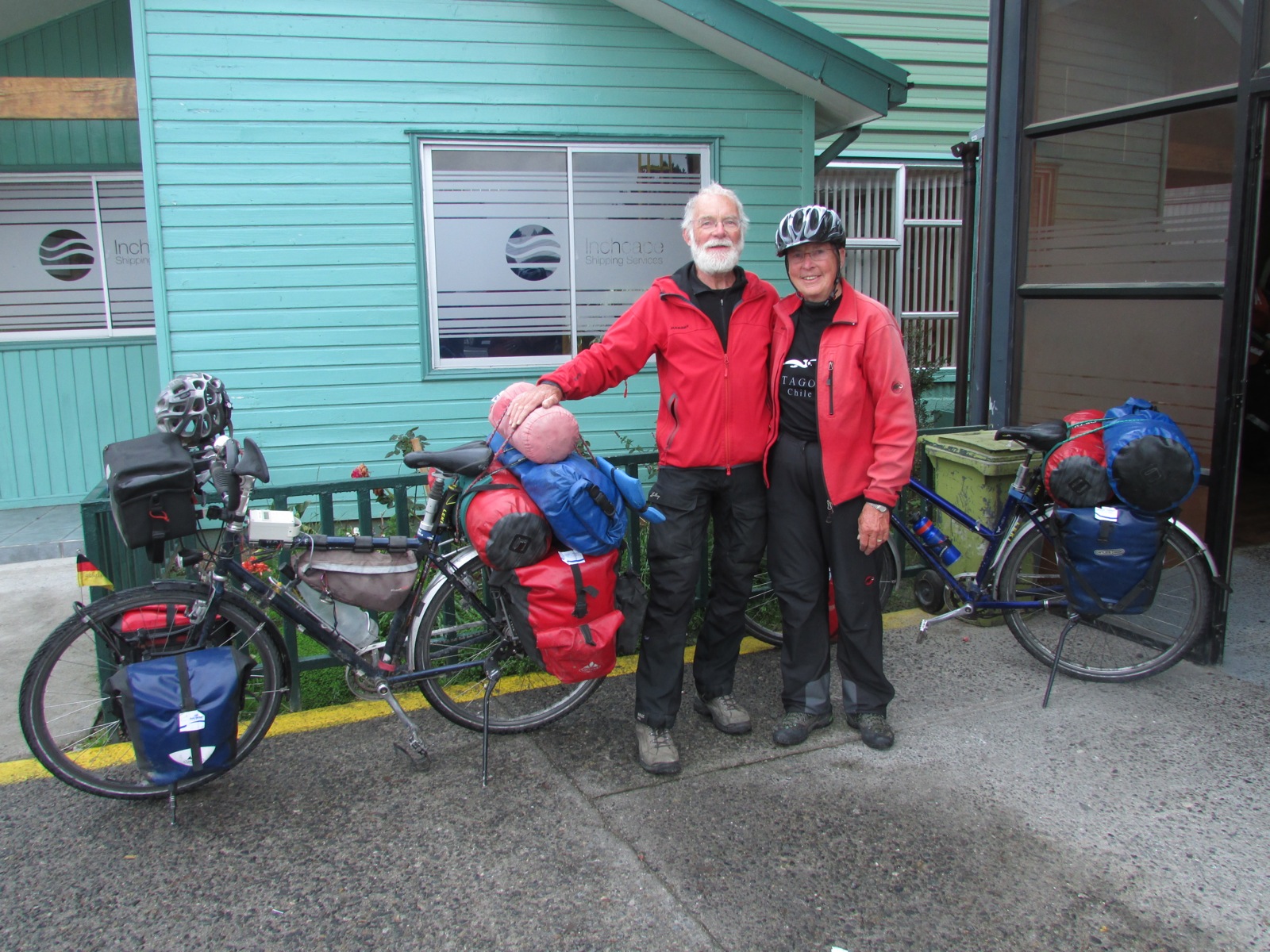
In our age group we have met a German couple (both 69) who cycled 6 weeks from Puerto Montt into Argentina and down to Puerto Natales, another couple who are traveling around the world for 14 months and a retired Italian following the same route as us.


And now for something completely different. With way too much free time, our female members soon found themelves dancing and singing from stern to bow, from port to starboard. So by popular demand we bring you one of their more inspired moments. Feel free to join the chorus. We are told that more is coming so stay tuned.
And here are some bonus pictures to share our experiences with our families and friends who we miss, even as we enjoy every moment of this journey.


The geezers´ shadows on the water